Monday, July 21, 2008

Rosemary Foccacia

My next bread from The Bread Bible was the Rosemary Foccacia. I have made foccacia a few times with other recipes, and this one is definitely the wettest. The dough starts out as soup, but after 20 minutes with the mixer, it is a lot more together with longs strands of gluten. It just plops out of the bowl after 4 hours of proofing, and you think 'this is never going to be bread, maybe pudding'. But after another hour of proofing and a short 20 minute bake, out comes a very light and airy bread.

I made this a bit taller as I wanted to use it for buns for some burgers. Very tasty and would make again.

Friday, July 18, 2008

Basic White Bread

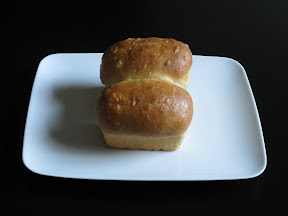
Ah yes, another bread from The Bread Bible. This is my favorite so far, it turned out perfect! I am so impressed with myself, the full loaf could be a wonderbread loaf! I think the difference is that I underproofed it a bit, and then let the oven spring take it the rest of the way. This gave it a good rise, light texture, and a great shape.
I only have one regular size loaf pan, and the recipe makes 2, so I divided the rest of the dough into 4 small loaf pans, very cute and my favorite.
This recipe would also work well for dinner rolls, breadsticks, etc. Very versatile wet dough.


Tuesdays with Dorie - Perfect Party Cake

I know we aren't suppose to go back and do old recipes, but chocolate pudding just isn't my thing. And, because I am posting this so late, let's just say I skipped this week :)

I am taking a cake decorating class with Steph from Frosted Garden, so I decided I should make a cake to practice with at home. This cake looked awesome, and it didn't disappoint. The cake is very light and lemony, and the swiss buttercream was very smooth and not overly sweet. I had been wanting to make a swiss buttercream since I had been reading my other blogs about them, and how you to have to whip it for a long time and it might look like it's falling apart but just keep whipping, so I had to try it out. Very tasty, but mine was a bit too soft to hold the details of the piping. But good none the less.

One change I made to the recipe was instead of raspberries, I made a mixed berry compote to put between the layers, and no coconut. Very yummy.

Perfect Party Cake, adapted from Dorie Greenspan:
For the Cake:
2 1/4 cups cake flour
1 tablespoon baking powder
½ teaspoon salt
1¼ cups whole buttermilk
4 large egg whites
1 ½ cups sugar
2 teaspoons grated Meyer lemon zest
1 stick (8 tablespoons or 4 ounces) unsalted butter, at room temperature
½ teaspoon pure lemon extract
For the Buttercream:
1 cup sugar
4 large egg whites
3 sticks (12 ounces) unsalted butter, at room temperature
¼ cup fresh Meyer lemon juice
For Finishing:
2/3 cup seedless raspberry preserves stirred vigorously or warmed gently until spreadable
About 1 ½ cups sweetened shredded coconut

Getting Ready:
Centre a rack in the oven and preheat the oven to 350 degrees F. Butter two 9 x 2 inch round cake pans and line the bottom of each pan with a round of buttered parchment or wax paper. Put the pans on a baking sheet.
To Make the Cake:
Sift together the flour, baking powder and salt.Whisk together the milk and egg whites in a medium bowl.Whisk together the sugar and lemon zest in a mixer bowl or another large bowl and rub them together with your fingers until the sugar is moist and fragrant. Add the butter and working with the paddle or whisk attachment, or with a hand mixer, beat at medium speed for a full 3 minutes, until the butter and sugar are very light.Beat in the extract, then add one third of the flour mixture, still beating on medium speed. Beat in half of the milk-egg mixture, then beat in half of the remaining dry ingredients until incorporated. Add the rest of the milk and eggs beating until the batter is homogeneous, then add the last of the dry ingredients. Finally, give the batter a good 2- minute beating to ensure that it is thoroughly mixed and well aerated. Divide the batter between the two pans and smooth the tops with a rubber spatula.Bake for 30-35 minutes, or until the cakes are well risen and springy to the touch – a thin knife inserted into the centers should come out clean
Transfer the cakes to cooling racks and cool for about 5 minutes, then run a knife around the sides of the cakes, unfold them and peel off the paper liners.Invert and cool to room temperature, right side up (the cooled cake layers can be wrapped airtight and stored at room temperature overnight or frozen for up to two months).
To Make the Buttercream:
Put the sugar and egg whites in a mixer bowl or another large heatproof bowl, fit the bowl over a plan of simmering water and whisk constantly, keeping the mixture over the heat, until it feels hot to the touch, about 3 minutes. The sugar should be dissolved, and the mixture will look like shiny marshmallow cream.Remove the bowl from the heat.Working with the whisk attachment or with a hand mixer, beat the meringue on medium speed until it is cool, about 5 minutes.Switch to the paddle attachment if you have one, and add the butter a stick at a time, beating until smooth.Once all the butter is in, beat in the buttercream on medium-high speed until it is thick and very smooth, 6-10 minutes.During this time the buttercream may curdle or separate – just keep beating and it will come together again.On medium speed, gradually beat in more lemon juice, waiting until each addition is absorbed before adding more, and then the vanilla. You should have a shiny smooth, velvety, pristine white buttercream. Press a piece of plastic against the surface of the buttercream and set aside briefly.
To Assemble the Cake:
Using a sharp serrated knife and a gentle sawing motion, slice each layer horizontally in half. Put one layer cut side up on a cardboard cake round or a cake plate protected by strips of wax or parchment paper.Spread it with one third of the preserves.Cover the jam evenly with about one quarter of the buttercream.Top with another layer, spread with preserves and buttercream and then do the same with a third layer (you’ll have used all the jam and have buttercream leftover).Place the last layer cut side down on top of the cake and use the remaining buttercream to frost the sides and top. Press the coconut into the frosting, patting it gently all over the sides and top.ServingThe cake is ready to serve as soon as it is assembled, but I think it’s best to let it sit and set for a couple of hours in a cool room – not the refrigerator. Whether you wait or slice and enjoy it immediately, the cake should be served at room temperature; it loses all its subtlety when it’s cold. Depending on your audience you can serve the cake with just about anything from milk to sweet or bubbly wine.
Storing:
The cake is best the day it is made, but you can refrigerate it, well covered, for up to two days. Bring it to room temperature before serving. If you want to freeze the cake, slide it into the freezer to set, then wrap it really well – it will keep for up to 2 months in the freezer; defrost it, still wrapped overnight in the refrigerator.


Tuesday, July 8, 2008

Baguettes

On my way through The Bread Bible, by Rose Levy Beranbaum, the Baguettes caught my eye. Nothing is terribly difficult about the recipe, but it does take a while before you are eating fresh, warm bread.

The recipe called for both a Pate Fermentee (a stiff dough that is fermented overnight in the fridge) and a Poolish (a more battery dough that is fermented overnight at room temperature). These both increase the flavor of the bread and allow you to use much less yeast than normal for this amount of dough.

One change I was forced to make in the recipe was to use about half whole wheat flour and half AP flour, as early on Sunday morning when I needed to mix the dough I realized I did not have enough AP flour and a trip to the store was not going to happen. I think this made the bread a bit less tender than the AP flour would have, but the bread had a nice flavor to it.

The baguettes came out well, I would have preferred a lighter texture, but again I attribute that to the whole wheat flour sub. I'll make them again with the correct flour mixture to test :)

And one other thing I accomplished with this bread was to hear it crack after I took it out of the oven. I have read on countless other blogs about this miraculous noise, but I have never heard it before. Then, all of the sudden, I started hearing this cracking noise when I took the bread out of the oven to cool! I guess I did something right with this recipe.

Tuesday with Dorie - Double Crusted Pie

The last few recipe choices have been great, they have all involved fruits that are in season now! I really like trying to eat seasonally, rather than trying to buy expensive fruits that have flown thousands of miles and don't really taste that great after all that. That being said, blueberries aren't very plentiful here in the oven we call Texas. So, I subbed out the blueberries for blackberries and peaches, both are getting to their peak here. I also used 1/4 cup of tapioca flour instead of the AP flour, I think it has less of a gritty taste and setting up clearer.

I also made a few smaller pies instead of one big one. I love individual sized treats, they are easier to serve, promote less of me eating a whole pie in one sitting, etc. I made 3 pies in a mega muffin pan, and one pie in a 5 inch square dish. Both of them tasted excellent, but I had some issues getting the pies out of the muffin pan. I used a silicon pan, thinking I could carefully pop them out once they had cooled, but the pies had a different idea about that. The 5 inch pie served up excellently, but is more than one normal serving.

I recommend this recipe, the crust stood up well with the fruit, even after a day or 2 in the fridge. If you don't have the book, you can get the recipe here at South in Your Mouth.

Tuesday, July 1, 2008

Tuesdays With Dorie - Apple Cheddar Scones

To start, let me say that I like scones but have never made them before so I was excited at the recipe choice. But then I realized that this weekend I had dedicated to the Daring Bakers Challenge of Danish Braids, and that recipe takes a lot of time and space, neither of which I have a lot of in my kitchen.

So on Saturday, I decided I could squeeze these in, but then I realized I did not have all the ingredients needed, namely the apples and cheddar :) I soldered on, and made them with peaches instead and froze them to bake off for Sunday's breakfast.

Well, I had a bit of an issue with the dough. Since I did not add the cheddar, it was much more unstable, too fragile to cut so I had to work in a bit more flour. After about 1/2 cup more, the dough was much more workable so I could cut out the scones.

They turned out ok, not my favorite scones but good for an easy Sunday breakfast.

Sunday, June 29, 2008

Daring Bakers - Danish Braid

The challenge this month was a danish braid, which involves an rich dough layered with butter to give it the nice rise and buttery flakiness that we all so enjoy. I've made danishes quite a few times, and have always had good results. They tend to be one of my most requested baked goods...

On to the recipe, it is a little different then the one I normally use, specifically it calls for orange zest and juice in the dough. I think this added a nice dimension to the finished product, so I will probably continue to add that in the future. Every time I make these I wish I had a dough sheeter :)

They came out really well. I decided to make nine smaller braids that are more easy to eat with your hands and have them not fall apart. I made the apple filling and used that for some. The rest I filled with a mixed berry compote that I made with strawberries, blueberries, raspberries and blackberries (all the berries are in season here now finally, so I couldn't resist using them all). I liked the berry mixture better, but I'm not a cooked apple fan so I could have been biased.

My friend came over and gave me a photography lesson, so hopefully my pictures from here out will be much higher quality. Thanks Dave! The picture is so much better I put it before the recipe :)


DANISH DOUGH


Makes 2-1/2 pounds dough

Ingredients
For the dough (Detrempe)
1 ounce fresh yeast or 1 tablespoon active dry yeast
1/2 cup whole milk
1/3 cup sugar
Zest of 1 orange, finely grated
3/4 teaspoon ground cardamom
1-1/2 teaspoons vanilla extract
1/2 vanilla bean, split and scraped
2 large eggs, chilled
1/4 cup fresh orange juice
3-1/4 cups all-purpose flour
1 teaspoon salt

For the butter block (Beurrage)
1/2 pound (2 sticks) cold unsalted butter
1/4 cup all-purpose flour

DOUGH
Combine yeast and milk in the bowl of a mixer fitted with the paddle attachment and mix on low speed. Slowly add sugar, orange zest, cardamom, vanilla extract, vanilla seeds, eggs, and orange juice. Mix well. Change to the dough hook and add the salt with the flour, 1 cup at a time, increasing speed to medium as the flour is incorporated. Knead the dough for about 5 minutes, or until smooth. You may need to add a little more flour if it is sticky. Transfer dough to a lightly floured baking sheet and cover with plastic wrap. Refrigerate for 30 minutes.

Without a standing mixer: Combine yeast and milk in a bowl with a hand mixer on low speed or a whisk. Add sugar, orange zest, cardamom, vanilla extract, vanilla seeds, eggs, and orange juice and mix well. Sift flour and salt on your working surface and make a fountain. Make sure that the “walls” of your fountain are thick and even. Pour the liquid in the middle of the fountain. With your fingertips, mix the liquid and the flour starting from the middle of the fountain, slowly working towards the edges. When the ingredients have been incorporated start kneading the dough with the heel of your hands until it becomes smooth and easy to work with, around 5 to 7 minutes. You might need to add more flour if the dough is sticky.

BUTTER BLOCK
1. Combine butter and flour in the bowl of a mixer fitted with a paddle attachment and beat on medium speed for 1 minute. Scrape down the sides of the bowl and the paddle and then beat for 1 minute more, or until smooth and lump free. Set aside at room temperature.
2. After the detrempe has chilled 30 minutes, turn it out onto a lightly floured surface. Roll the dough into a rectangle approximately 18 x 13 inches and ¼ inch thick. The dough may be sticky, so keep dusting it lightly with flour. Spread the butter evenly over the center and right thirds of the dough. Fold the left edge of the detrempe to the right, covering half of the butter. Fold the right third of the rectangle over the center third. The first turn has now been completed. Mark the dough by poking it with your finger to keep track of your turns, or use a sticky and keep a tally. Place the dough on a baking sheet, wrap it in plastic wrap, and refrigerate for 30 minutes.
3. Place the dough lengthwise on a floured work surface. The open ends should be to your right and left. Roll the dough into another approximately 13 x 18 inch, ¼-inch-thick rectangle. Again, fold the left third of the rectangle over the center third and the right third over the center third. No additional butter will be added as it is already in the dough. The second turn has now been completed. Refrigerate the dough for 30 minutes.
4. Roll out, turn, and refrigerate the dough two more times, for a total of four single turns. Make sure you are keeping track of your turns. Refrigerate the dough after the final turn for at least 5 hours or overnight. The Danish dough is now ready to be used. If you will not be using the dough within 24 hours, freeze it. To do this, roll the dough out to about 1 inch in thickness, wrap tightly in plastic wrap, and freeze. Defrost the dough slowly in the refrigerator for easiest handling. Danish dough will keep in the freezer for up to 1 month.

APPLE FILLING
Makes enough for two braids

Ingredients
4 Fuji or other apples, peeled, cored, and cut into ¼-inch pieces
1/2 cup sugar
1 tsp. ground cinnamon
1/2 vanilla bean, split and scraped
1/4 cup fresh lemon juice
4 tablespoons unsalted butter

Toss all ingredients except butter in a large bowl. Melt the butter in a sauté pan over medium heat until slightly nutty in color, about 6 - 8 minutes. Then add the apple mixture and sauté until apples are softened and caramelized, 10 to 15 minutes. If you’ve chosen Fujis, the apples will be caramelized, but have still retained their shape. Pour the cooked apples onto a baking sheet to cool completely before forming the braid. (If making ahead, cool to room temperature, seal, and refrigerate.) They will cool faster when spread in a thin layer over the surface of the sheet. After they have cooled, the filling can be stored in the refrigerator for up to 3 days. Left over filling can be used as an ice cream topping, for muffins, cheesecake, or other pastries.

DANISH BRAID
Makes enough for 2 large braids

Ingredients
1 recipe Danish Dough (see below)
2 cups apple filling, jam, or preserves (see below)

For the egg wash: 1 large egg, plus 1 large egg yolk

1. Line a baking sheet with a silicone mat or parchment paper. On a lightly floured surface, roll the Danish Dough into a 15 x 20-inch rectangle, ¼ inch thick. If the dough seems elastic and shrinks back when rolled, let it rest for a few minutes, then roll again. Place the dough on the baking sheet.
2. Along one long side of the pastry make parallel, 5-inch-long cuts with a knife or rolling pastry wheel, each about 1 inch apart. Repeat on the opposite side, making sure to line up the cuts with those you’ve already made.
3. Spoon the filling you’ve chosen to fill your braid down the center of the rectangle. Starting with the top and bottom “flaps”, fold the top flap down over the filling to cover. Next, fold the bottom “flap” up to cover filling. This helps keep the braid neat and helps to hold in the filling. Now begin folding the cut side strips of dough over the filling, alternating first left, then right, left, right, until finished. Trim any excess dough and tuck in the ends.

Egg Wash
Whisk together the whole egg and yolk in a bowl and with a pastry brush, lightly coat the braid.

Proofing and Baking
1. Spray cooking oil (Pam…) onto a piece of plastic wrap, and place over the braid. Proof at room temperature or, if possible, in a controlled 90 degree F environment for about 2 hours, or until doubled in volume and light to the touch.
2. Near the end of proofing, preheat oven to 400 degrees F. Position a rack in the center of the oven.
3. Bake for 10 minutes, then rotate the pan so that the side of the braid previously in the back of the oven is now in the front. Lower the oven temperature to 350 degrees F, and bake about 15-20 minutes more, or until golden brown. Cool and serve the braid either still warm from the oven or at room temperature. The cooled braid can be wrapped airtight and stored in the refrigerator for up to 2 days, or freeze for 1 month.